Latest
CES 2026/Strategic MOUs signed at CES 2026 Las Vegas — ARVIVA Therapeutics, Korea Lighting & Morla Moves.
1 / 4
ENG/KOR
Contact

MTechLab

Analysis Module

Brain Segmentation

Fully automated volumetric segmentation of the whole brain from T1-weighted MRI — delivering atlas-labelled region maps and quantitative volume reports in a single click.

90+Brain regions
< 10mProcessing time (CPU)
4Atlas frameworks
3T / 7TField strengths

Module Overview

Deep-learning morphometry, delivered at the workstation

The Brain Segmentation module applies a convolutional neural network trained on thousands of manually annotated MRI volumes to structural T1 scans, automatically identifying and measuring every major brain region. No manual seed-point placement or parameter tuning required — the model self-adapts to scanner field strength and acquisition protocol.

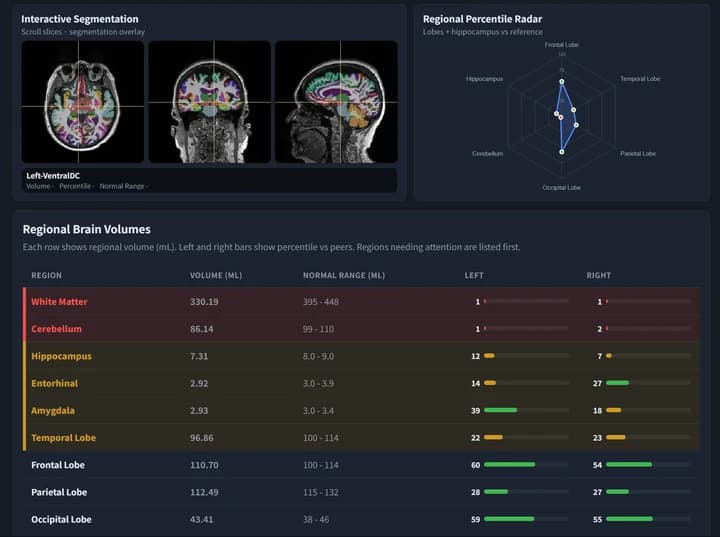
Results are delivered as colour-coded overlay images, a detailed volumetric table, and a one-page clinical summary PDF — all within the same desktop session. Patient data never leaves the institution.

Output artefacts

Region overlayColour-coded NIfTI aligned to source
Volume tableCSV / XLSX, one row per region
Clinical PDFOne-page summary with normative flags
Atlas labelsAAL3 · DK · Harvard-Oxford · Brodmann

Key Capabilities

What the module delivers

Atlas-based parcellation

Automated segmentation of 90+ cortical and subcortical regions using AAL, Desikan-Killiany, Harvard-Oxford, and Brodmann frameworks.

Normative comparison

Volumetric measurements are benchmarked against age-matched reference ranges, with deviations flagged in the clinical report.

Multi-sequence compatibility

Accepts T1-weighted MPRAGE, MP2RAGE, and FLASH acquisitions from both 3T and 7T systems with no manual protocol configuration.

Sub-mm precision

Full hemisphere segmentation completed in under 10 minutes on CPU, under 3 minutes on GPU — at sub-millimetre resolution.

Technical Specifications

v2 module
Supported sequencesT1w MPRAGE · MP2RAGE · FLASH
Field strengths3T and 7T MRI systems
Input formatsDICOM · NIfTI (.nii / .nii.gz)
Atlas optionsAAL3 · Desikan-Killiany · Harvard-Oxford · Brodmann
OutputCSV/XLSX volume table · overlay NIfTI · PDF report
Processing time< 10 min per subject (CPU) · < 3 min (GPU)
Minimum resolution1 mm isotropic T1

AI Automation

All segmentation is driven by a CNN trained on thousands of manually annotated MRI volumes. The model self-adapts to scanner field strength and protocol, making it suitable for multi-site studies and routine clinical workflows alike — no calibration scans or site-specific tuning required.

Get Started

Interested in the MRI Analysis Service?

Speak with our team about a pilot programme or custom integration.